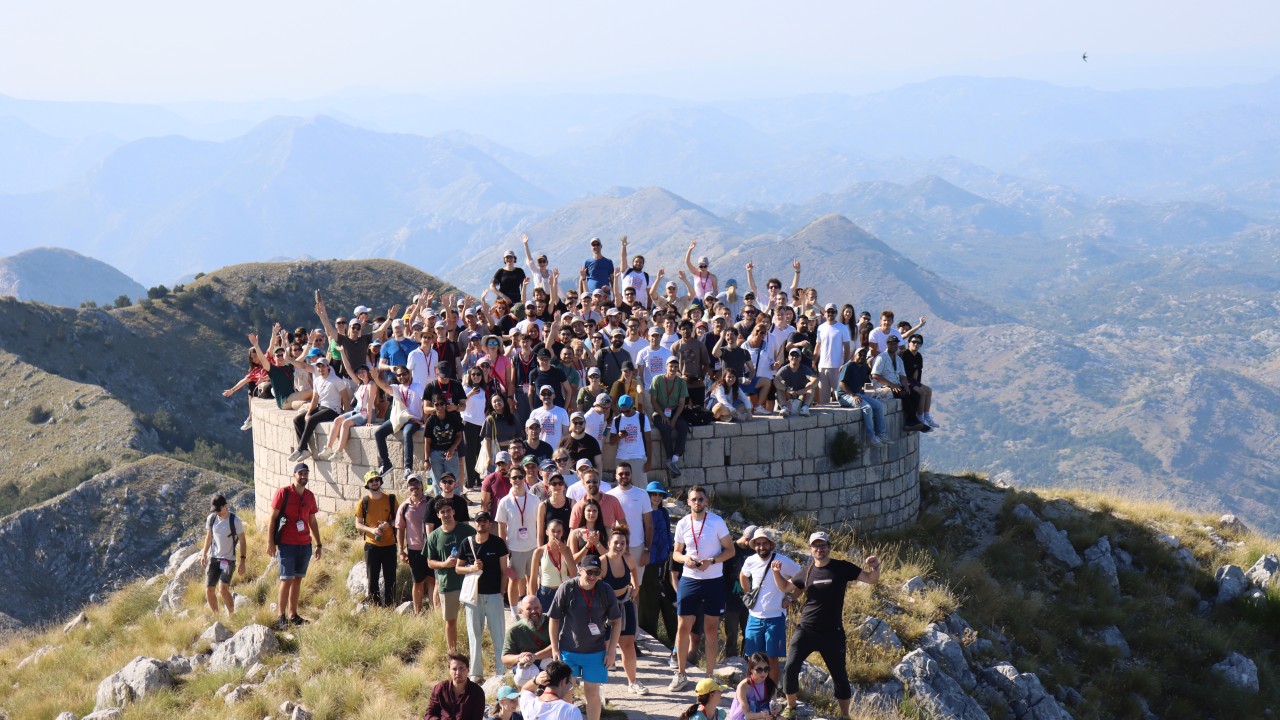
After spending one week at EEML 2026, I can easily say that it was one of the best machine learning summer schools I have ever attended. It was definitely the warmest and most welcoming one.
The backgrounds of the lecturers were impressive, and the technical content was extremely strong. The participants also came from a very wide range: high-school students, undergraduate and graduate students, PhD researchers, and people from industry. What surprised me was that, despite this wide range, the general level was very high.
Because of this, learning did not stop when the lectures ended. Many conversations during coffee breaks, meals, tutorials, and social events were as informative as the official program.
One of the best places for these conversations was the poster session.
The posters were not random projects that people prepared just to fill an empty wall. Everyone had already submitted an extended abstract during the application process, and some of these projects were selected for the poster sessions. So people took their posters seriously. It was a real showcase.
I also spent special effort on mine.
Unfortunately, I could not give 100% of my attention to the summer school. During the day, I attended lectures. In the evenings, I tried to find a quiet corner and worked until I went to sleep. Sometimes I even had meetings during breakfast, lunch, or lecture breaks.
Projects back in Türkiye do not care that you are attending a summer school. And if those projects are your own, vacation is a concept you have to remove from your life. 🥶
Still, I wanted my poster to be good.
So, one day before the poster session, I started working on it at around 4 p.m. I continued until 5 a.m.
As with every task I leave until the last minute, my procrastination instinct appeared again. Of course, I do not call it procrastination. I call it “efficiency anxiety.”
I thought:
Why should I prepare only one poster? Why not also build a poster-generator automation (say wut?! 🤯), learn a new design method, and solve all my future poster problems at the same time?
One stone, several birds.
This is a strange habit I have had since my school years. For example, when I had a Calculus exam the next day, I would first spend hours searching for the perfect Calculus textbook.
I would examine all the books. How did they explain the topics? How did they solve the problems? What was the expertise of the author? Was the author also a good teacher?
After finding the ideal book, there was usually not much time left to study.
I would enter the first exam with little preparation and receive a bad grade. But all that research would make me much faster for the following exams. Then I would get very high grades and finish the semester successfully.
At some point, I stopped fighting this procrastination instinct and learned how to turn it into an investment.
The same thing happened on poster night.
I had not prepared a scientific poster for years, so I had no template in my mind. I opened Overleaf and started looking at poster templates.
Most of them were the same: many boxes, long paragraphs, small figures, and enough text to punish anyone who came close. I have never liked academic posters. Researchers put so much detail on them that sometimes I think they could simply print the PDF of the paper in poster size and finish the job.
Then I found a very different design: Better Poster, created by psychologist and designer Mike Morrison, Ph.D .
The idea was simple. Use a very large title and give almost half of the poster to one main idea or main finding. Put only a few figures and short explanations around it. If someone wants all the technical details, they can scan a QR code and read the paper.
His argument was also simple: while visitors walk through a poster session, they normally give your poster only a few seconds. If they are interested, maybe 30 seconds. If they are very interested, they stop and speak with you.
Almost nobody reads all the tiny paragraphs researchers put on posters.
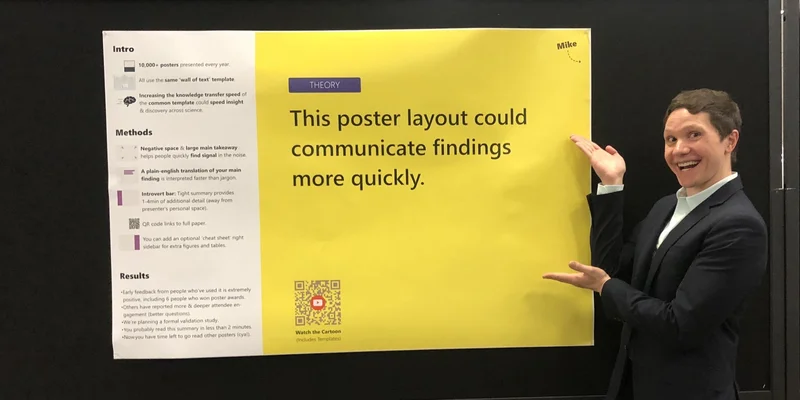
This design philosophy was very attractive to me. I had only a few hours, and I did not want to spend several days moving boxes by two millimeters.
But, of course, my “efficiency anxiety” returned.
I decided that I should also build an automation around this design. My goal was to generate my future posters from a paper PDF in about one hour.
Claude Code was already reasonably good at creating posters, but professional output still required many small corrections. So I created a detailed BetterPosterAutomation.md file. It included the Better Poster layout, a local TeX environment, suitable fonts, colors, margins, storytelling rules, and even detailed steps for creating custom vector icons.
After many iterations, bug fixes, and new instructions, I finished the automation file at around 3 a.m.
Then I gave Claude the paper PDF and the automation instructions.
I sat back.
It took around two hours, but the final result was exactly what I wanted. The top section explained the entire project in about ten seconds:
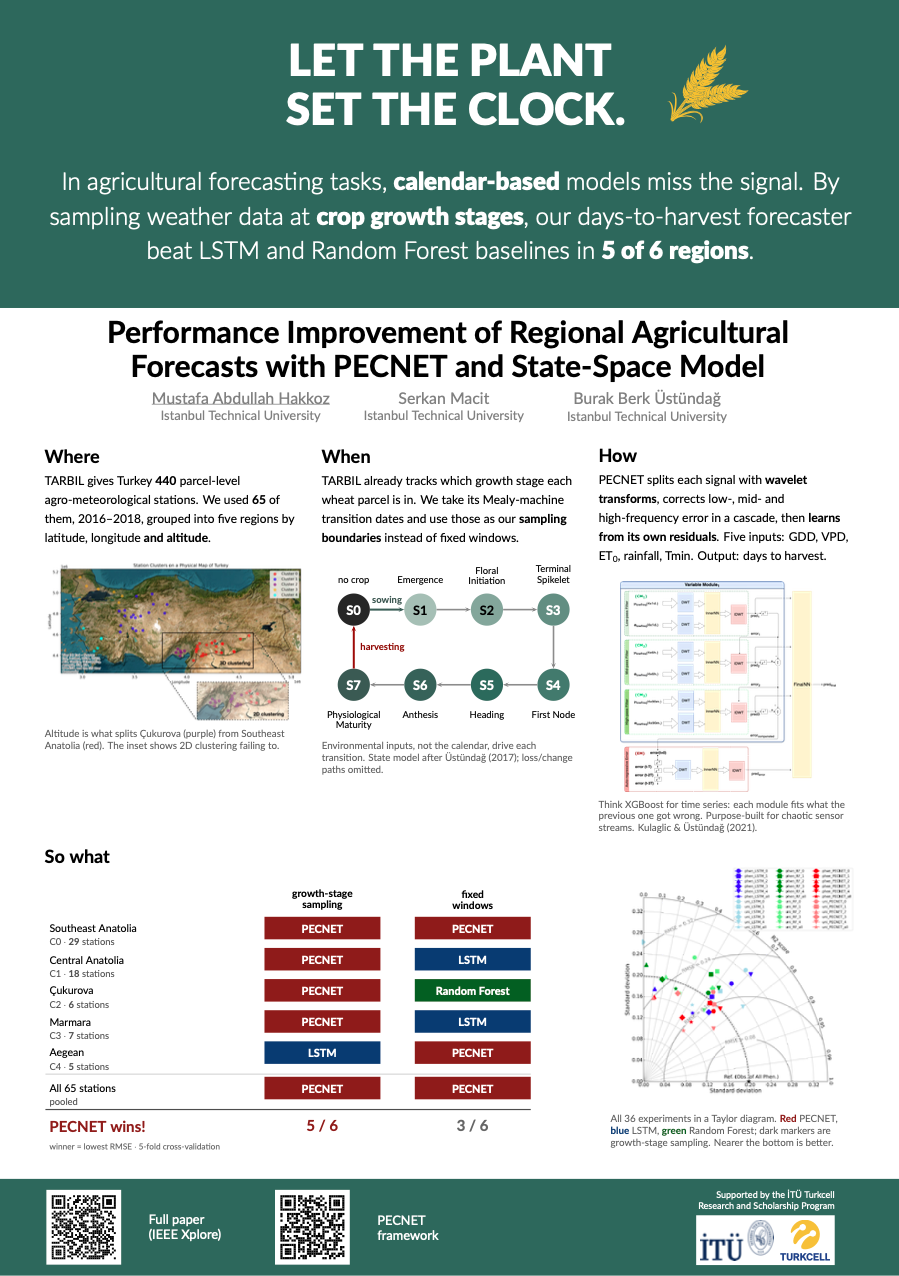
The “Where, When, and How” sections told the technical story with three visuals. The “So What” section showed the results. There was very little text. QR codes directed interested people to the full paper and the codebase of the work which is PECNET framework.
The project itself came from a conference paper I prepared during the early period of my grad days: “Performance Improvement of Regional Agricultural Forecasts with PECNET and State-Space Model.”
The poster explained the whole story in a few seconds:
The task was remaining-days-to-harvest prediction. Where? Agricultural stations across Türkiye. When? The plant’s growth stages set the clock, not fixed calendar windows. How? PECNET separates the signal with wavelets and learns from its own prediction errors. So what? It beat the baselines in five of six growth-stage sampling settings.
That was enough.
If someone wanted Mealy machines, wavelet decomposition, regional clustering, autoregressive error compensation, 36 experiments, RMSE values, and more academic blah blah, they could scan the QR codes and read the paper.
The poster’s job was not to explain every detail. Its job was to make someone stop.
I even prepared a small challenge. When someone looked at the poster, I planned to say:
“Hey, I have a challenge for you. Can you understand my project in 30 seconds?”
Of course, I was not really going to give them 30 seconds. After ten seconds, I could say,
“Time’s up! Heh heh…”
Once the hook worked, we could talk for a few minutes, exchange contacts, and maybe find opportunities for future collaboration.
A perfect plan. What could possibly go wrong? 🫠
JUDGMENT DAY
After finishing both the poster and the automation, I started the next day with three or four hours of sleep.
Not a terrible trade, I thought.
The print shop produced the poster in ten minutes that morning. Unfortunately, two valuable lectures were mostly sacrificed to my sleep deprivation. “Information Propagation” by Federico Barbero and “Continual Learning” by Clare Lyle .
I was physically present. My brain was not.
The afternoon lecture, after drinking coffee , was excellent. Its official title was “Lecture TBD” by Razvan Pascanu . Yes, that was really the title. Because why not? 🙂
He spoke about specialist cats, generalist mites, origami, King Midas, and many other things. What did all of this have to do with AI? Because why not? 🙂
After surviving the lectures and tutorial session, I finally reached the poster session.
My poster area was in a narrow corridor. This was probably the only serious criticism I could make about the whole event. I am not someone who cares much about hotel rooms, conference chairs, or luxury. I grew up in public dormitories. My standards for physical comfort are very low.
But that poster corridor was something else.
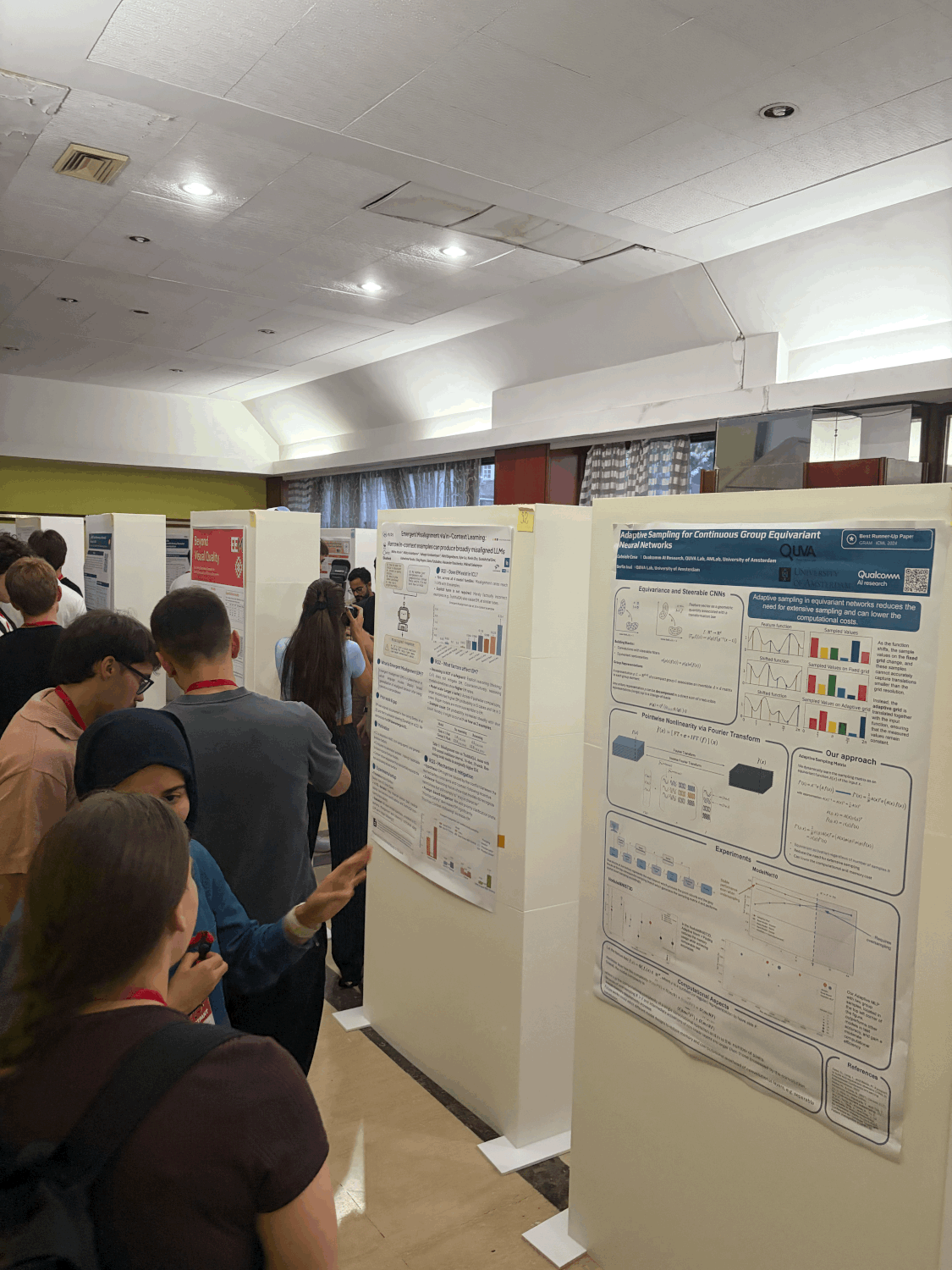
The posters were already very close to each other. Then more than a hundred participants attacked the corridor at the same time.
It was around 30°C outside. Inside, it felt like 40°C.
The hotel looked like a historical Yugoslavian building from the 1980s that had somehow escaped renovation. Wooden decoration, old curtains, strange lighting. A very mystical atmosphere.
And the noise was incredible. Normal conversation was almost impossible. My poster was close to the entrance, so I was trapped in the middle of the crowd.
You may now be asking: “Why are you describing the environment like Tolkien? Is this a LinkedIn article or The Lord of the Rings?”
All of this description is necessary. I want you to feel my mental condition, and the stupidity I was about to perform, in your bones. 🙃
While I was slowly dying next to my poster, a friendly and smiling man approached. He looked young, kind, and surprisingly boyish, almost exactly like his profile photo.

He looked at the poster.
Probably a grad student, I thought. 🥲
So I did “my thing.”
“Hey, I have a challenge. Would you like to try?”
“Sure,” he said.
“Can you understand the project in 30 seconds?”
He narrowed his eyes, studied the poster, and nodded.
The hook had worked.
Very pleased with myself, I explained that I was testing a new poster design. I had tried to keep everything simple. I had used a template created by a designer, and I wanted to see whether people would give positive feedback.
He gave me a thumbs-up. Then he asked me to explain the actual project.
I started with the simple version:
“TARBIL was a large precision-agriculture project in Türkiye. We had 440 agricultural stations collecting parcel-level data. Unfortunately, the project is no longer active, but terabytes of data are still waiting on our servers.
“This was one of our early experiments. It is a time-series regression problem. We predict the remaining days to harvest. We have two main contributions: phenology-aware sampling instead of uniform sampling, and a special forecasting model for chaotic time series.”
I was explaining everything as simply as possible because I thought he was another participant. Maybe a master’s student. That was a compliment, by the way. He looked very young. 🥲
I was planning to finish there. But he continued.
“What kind of model is it?” he asked.
My internal voice said:
Brother, please do not block the traffic.
Four or five other people had already passed behind him while we were talking.
I did not show this on my face. But unfortunately, I can become slightly arrogant in situations like this. 😇
So I asked him:
“Have you heard of XGBoost?”
Yes. I asked that exact question. 🤦
I asked this guy ⬇️ if he knows XGBoost.
Anyone who recognized the man from his photo has probably already started facepalming. 🤦🤦🤦
He looked calm and polite**.** He did not destroy me. He simply nodded indulgently.
I continued:
“Good, you can think of this model as XGBoost for time series. It has a similar cascaded error-correction idea, with our own sauce: wavelet transforms.”
Then I stopped. It should be enough. I did not want to explain more. I wanted the traffic to continue.
When he understood that he was not going to get a longer answer from me, he moved closer and inspected the architecture figure.
He started humming and nodding. I interrupted:
“There is nothing extremely special. We mostly combine several classical ideas. The project is not very complex.”
At this point, I had started insulting my own project so that he would leave.
Then he asked:
“May I make a suggestion?”
Inside my mind, I said:
Okay, my friend. Let us hear your suggestion.
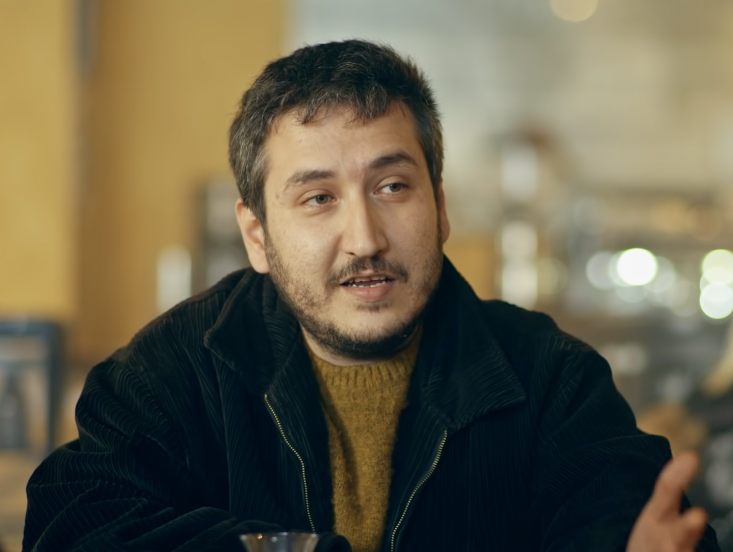
My face probably looked exactly like that.
“Have you tried rotary embeddings?” he asked, very politely.
By now, my arrogance had reached the roof. I replied with something like:
“Does this model look like an LLM to you? It is a tiny model. Maybe we could try that if it was a Transformer. Nice suggestion, though.”
Facepalm. 🤦🤦🤦
I had just dismissed a suggestion from Professor Phillip Isola .
For people outside computer vision: He is one of the researchers behind some of the works that helped bring modern generative vision into the mainstream.
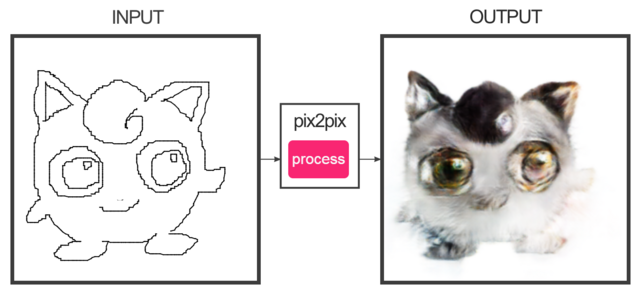
You may remember models that translate sketches into realistic images. That is pix2pix.
You may remember the models that translate between visual domains without paired examples. That is CycleGAN.
More recently, he was also one of the authors of “The Platonic Representation Hypothesis”, one of the most discussed machine learning papers of recent years. Even I, had used that paper many times in AI conversations. It is a very useful paper when you want to sound clever. I have eaten a lot of bread from it. 😎
Apparently, I had never properly learned what its author looked like. 🫠
Even worse, he had given a lecture on the first day of EEML. I had been there. But because I was half asleep, I had not properly listened.
The man was still standing in front of me, and I still had not understood what had happened.
He thanked me, and I thanked him. I asked his name and whether he was also a participant. He showed me his badge.
“Phillip,” he said.
Until that moment, I had not even looked at his name tag. Because of the heat, noise, crowd, and sleep deprivation, my brain was operating with emergency power. I saw only two words on the badge:
Lecturer
and
Phillip
I still did not read the surname.
I thought:
Well, this is slightly embarrassing. He is a lecturer. I hope he did not misunderstand me.
Then we said goodbye.
Somehow, I survived the rest of the poster session. After it ended, I went to my hotel room to rest. I opened the program to check who this lecturer was.
And then I saw it.
Phillip Isola.
Oh no... 😱
POST-TRAUMATIC STRESS DISORDER
I have only a few people in the AI world for whom I have real fanboy energy. My short list is something like:
Hinton. Ng. Karpathy. Goodfellow. Isola.
One of them had attended the same program as me.
He had given a lecture, and I had failed to listen.
He had visited my poster, and I had failed to recognize him.
He had offered a technical idea, and I had basically replied:
“Nice try, little participant.”
Wherever you look at it from, this was a high-quality failure. 💩💩💩
My method for dealing with the trauma was simple:
I told the story to everyone.
If I had kept it inside, I would not have slept from the pain. That is also why I am now sharing it on LinkedIn. You are free to roast me. 🤡
Of course, if I had recognized him earlier, we could have had a much more useful conversation. I could have asked why he thought rotary positional embeddings might help. He could probably have directed me toward an interesting research path in a few sentences.
I normally love receiving advice from experienced people. I swear.
I value expertise, experience, and ideas that have survived the test of time. But after thinking about this story, I realized that the real lesson was deeper.
The main problem was not that I failed to recognize a famous researcher.
The main problem was that I decided how much attention to give his idea based on who I thought he was.
If he had been an undergraduate student, his question would still have deserved a proper technical answer. If an idea becomes valuable only after I read the surname on the badge, then the real problem is not the badge.
It is my listening.
I did not want to remember that night only as a missed opportunity.
I chose the path of redemption.
That night, despite the sleep deprivation, I started studying the keyword he had given me.
Of course, I already knew rotary positional embeddings (RoPE). I knew that they were one of the important ideas behind modern language models. I also knew that positional encodings had been used in time-series models.
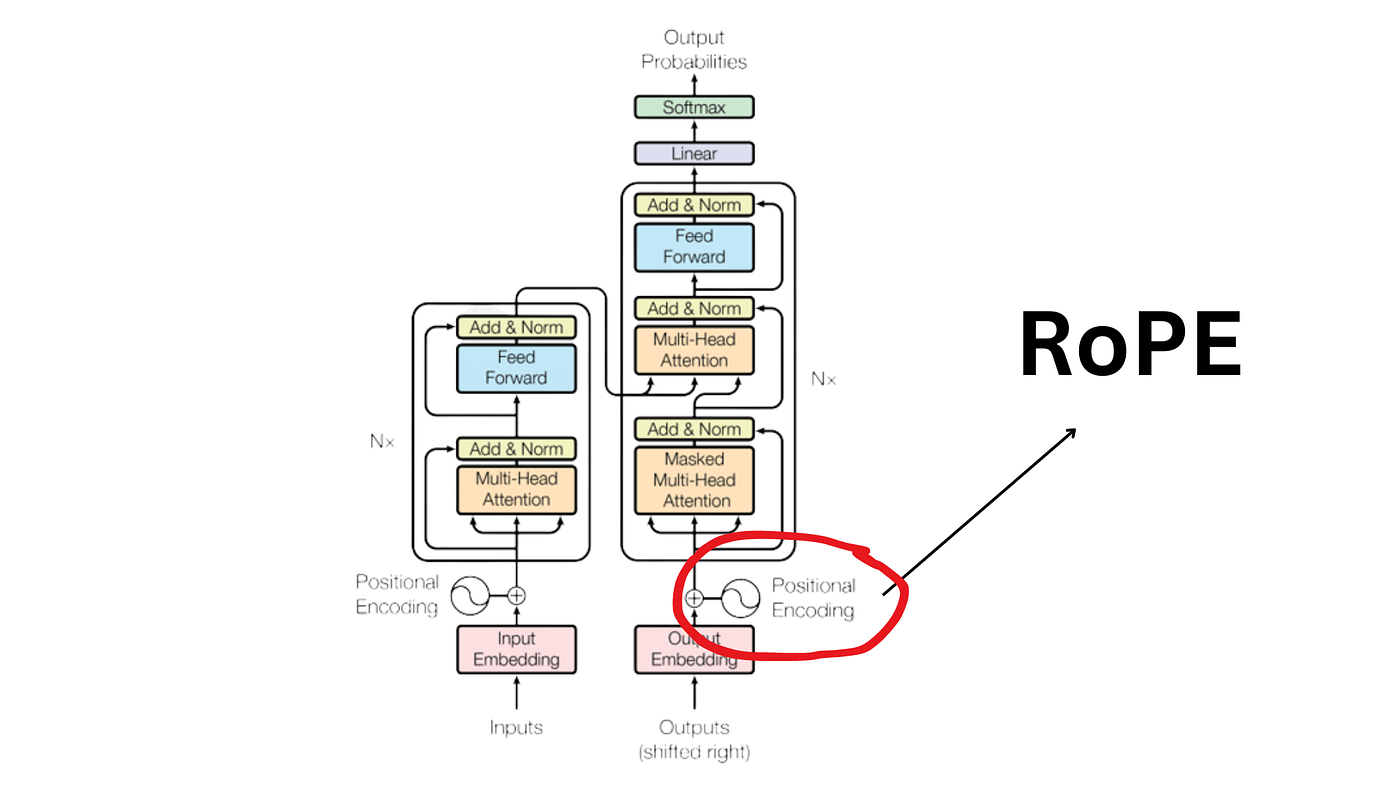
But I had never seriously considered them for PECNET.
Our model worked with very short windows, usually around 4 or 8 steps. It did not use a Transformer or self-attention. Its internal prediction modules were relatively small neural networks.
At first, RoPE looked irrelevant.
The original RoFormer paper applies a position-dependent rotation to query and key vectors. The absolute position controls the rotation angle, while the dot product between rotated queries and keys naturally contains relative-position information.
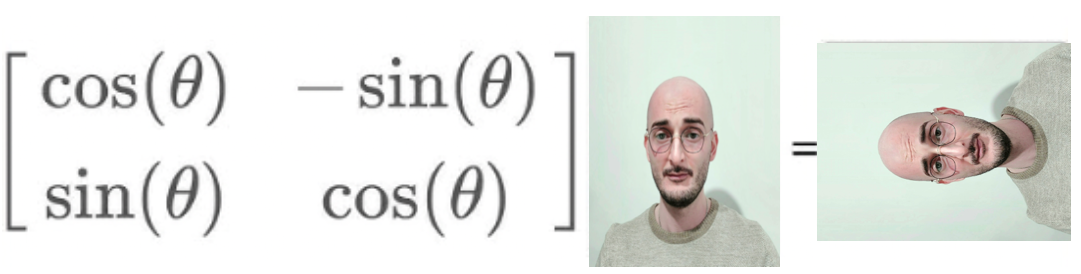
So RoPE is not simply another vector added to the input. It changes the geometry of the attention operation.
But, PECNET did not even have an attention mechanism. Why would I use RoPE there?
But then I asked a better question:
Why am I so sure that PECNET must continue using only small MLP-based modules?
I had been proud of the size of our agricultural dataset in my talk. We had enough data to test a more expressive architecture.
I used to create a strong belief in my words:
“PECNET works with windows of 4 or 8. It does not work with longer windows.”
Why?
"Because performance had decreased when we increased the window size."
I had treated this empirical result as a permanent law of nature. That was tunnel vision.
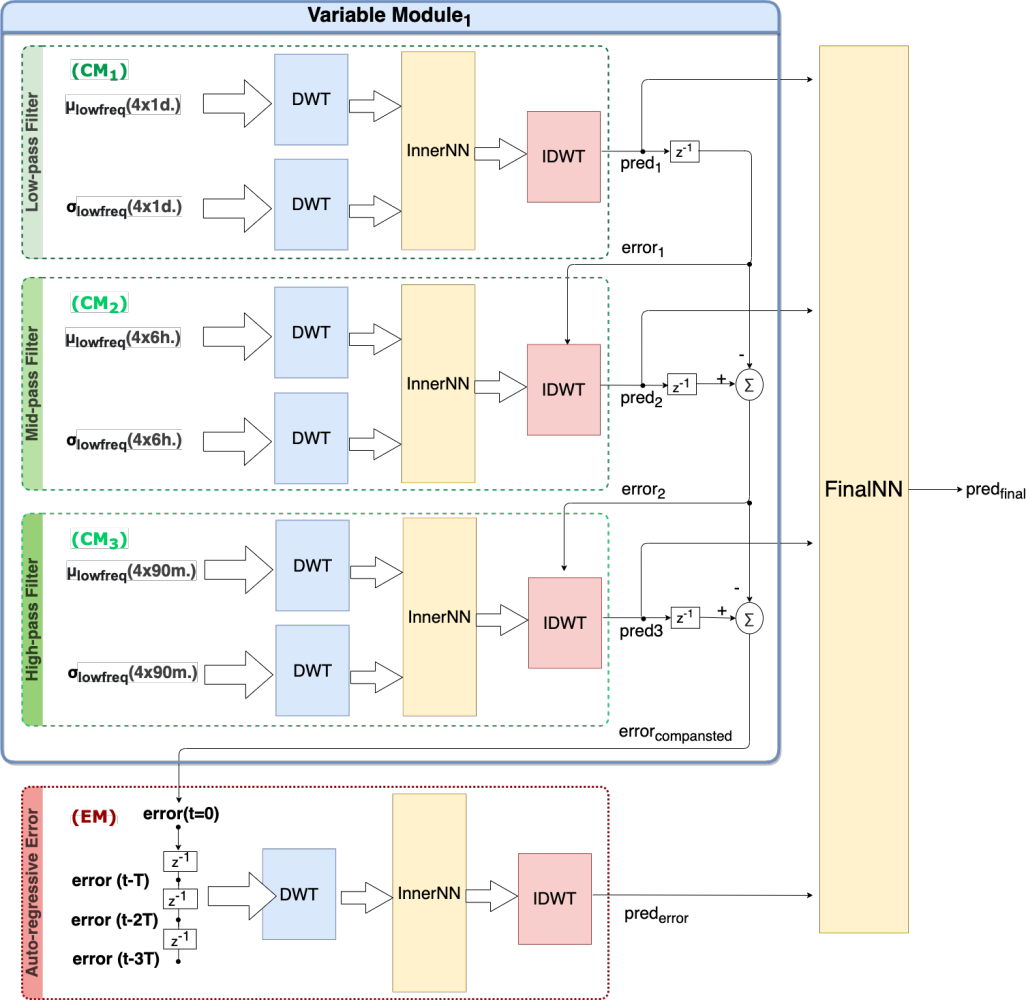
One possible reason for the performance loss was that the model did not have an explicit mechanism designed to represent relative temporal positions over longer windows. The fixed MLP input could learn some positional structure, but it might not scale well when the sequence became longer and noisier.
This was only a hypothesis. RoPE was not automatically the solution. The degradation could also come from optimization difficulty, overfitting, noisy history, or the PECNET architecture itself.
But RoPE gave me a concrete way to test the position hypothesis.
To use it properly, I would probably need to redesign part of PECNET. For example, I could add a small attention module, use rotary mappings before the prediction blocks, or build a hybrid PECNET-Transformer architecture.
Then I could compare window sizes such as 4, 8, 16, 24, and 48 under several positional strategies:
- no explicit positional encoding,
- classical sinusoidal encoding,
- learned positional embeddings,
- RoPE,
- and task-specific rotary frequencies.
I read the RoFormer paper several times.
I also studied “Round and Round We Go! What Makes Rotary Positional Encodings Useful?”. This paper made the problem even more interesting. It shows that RoPE’s behavior is more complex than the simple story that attention should decrease with distance. Different frequency components may play different roles. High frequencies can support strong positional patterns, while low frequencies may carry other information.
This also raised a practical question for my time-series setting.
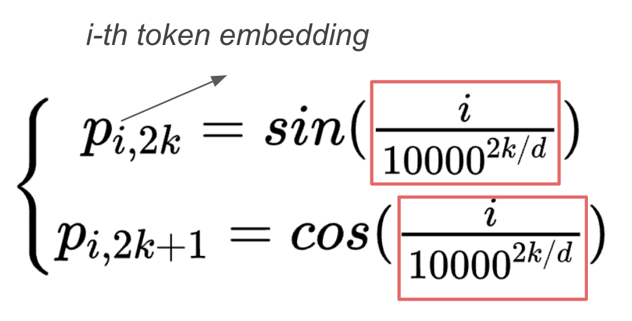
The default theta frequency base parameter (often 10,000) comes from long-sequence language-model conventions. Why should that value be optimal for a time-series window of only 24 or 48 steps?
It probably is not.
The frequency spectrum should become a task-dependent hyperparameter. There may be a sweet spot based on sampling rate, expected periodicity, window size, and the physical dynamics of the signal.
For building intuition, I also recommend this video from the ExplainingAI channel. It gives a very clear geometric explanation of RoPE.
And then, naturally, the idea tree started growing.
RoPE led me to Fourier feature mappings.
The XGBoost analogy led me back to Newton boosting and second-order optimization.
The agricultural data led me to causality analysis and automatic feature selection.
Then I reopened the XGBoost and LightGBM papers because I had used their names so confidently during my talks. I revisited ideas such as Gradient-based One-Side Sampling (GOSS), which keeps high-gradient examples while sampling from low-gradient ones, together with several pruning and efficiency strategies.
I stole many ideas. Academically, of course. 🤓
There were also several more ideas that I will not mention yet. They are secret.
At around 5 a.m., I had a 39-page document:
PECNETv2_upgrade_ideas.docx
I could not have the proper conversation with Professor Isola during the poster session. But I worked seriously on the idea he gave me.
I converted embarrassment into potential research value.

Now comes the difficult part: implementing the architecture and running thousands of ablation experiments.
If the idea works, I would thank Professor Phillip Isola in the paper. Maybe that will finally give his suggestion the credit it deserved.
Long story long, here is the lesson I brought home from EEML:
Do not decide how valuable a question is by looking at the badge or by guessing what the badge probably says.
The more serious lesson is even simpler:
Sleep before your poster session.
See you guys. Until the next high-quality failure. 😆